Finding Your Right Vocation – Interaction at S.I.E.S. College, 2020
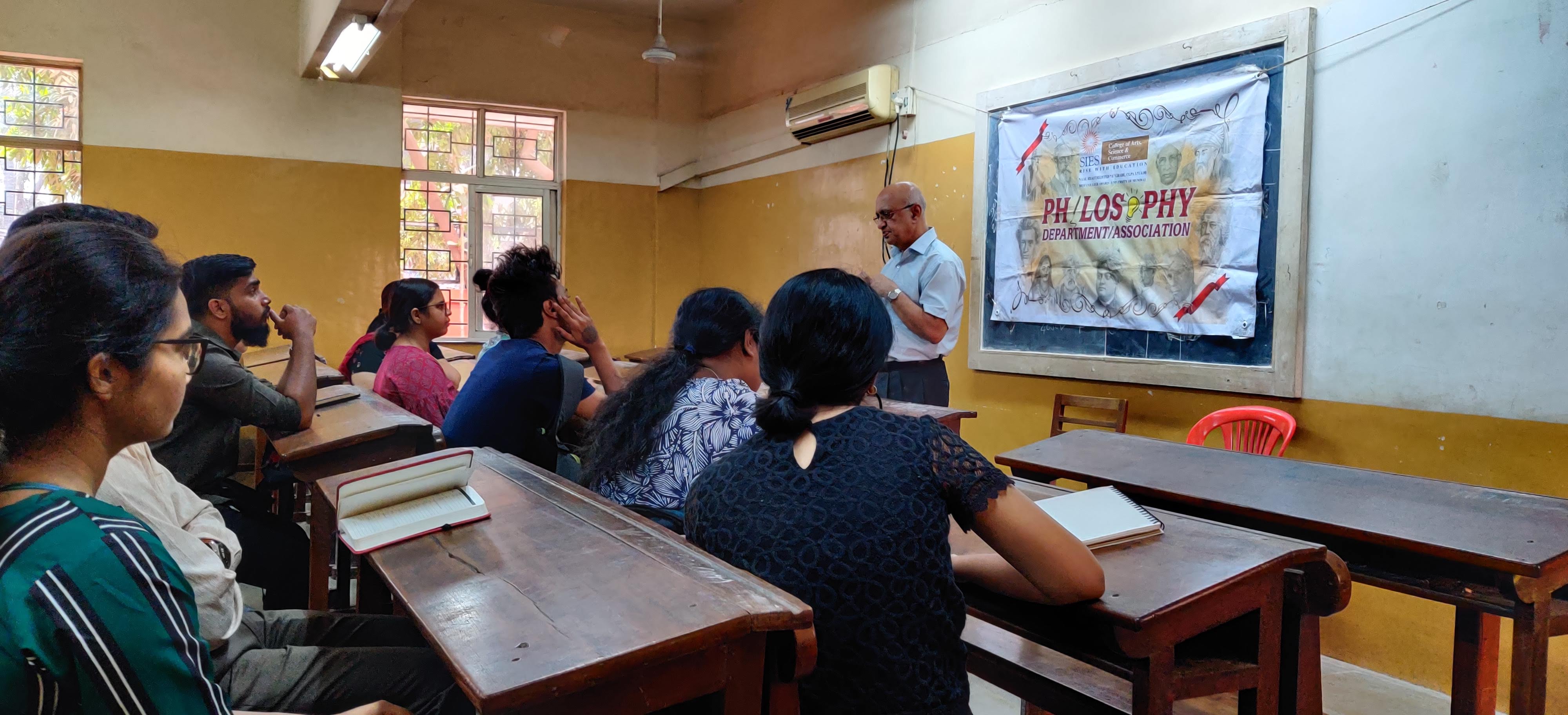
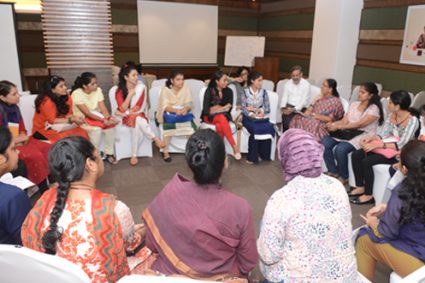
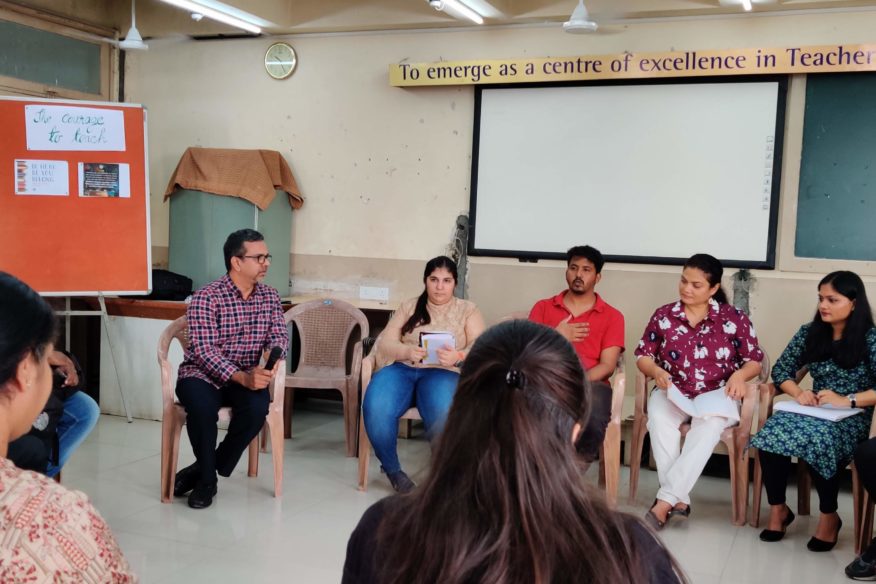
Fr. Lancy Prabhu held an interaction with the senior students of Philosophy in S.I.E.S. College in Sion on 29th February 2020. The topic was ‘Finding the Right Vocation’. He opened the session with an introduction to Krishnamurti and his teachings as a background for the main topic. He spoke about how Krishnamurti was unique in the way he impacted the consciousness of mankind.
Speaking about the present state of the world, he explained how trying to bring about outer reforms is futile since our inner state of the mind will continue to create the same kind of society. He pointed out how the present system of education, with its emphasis on knowledge and examination-grades, is almost exclusively focused on making the younger generation ready for the various industries. He spoke about how it is more important for the student to understand oneself, which requires that he or she is free from psychological pressures and problems from very early years.
Fr. Prabhu told the students that Krishnamurti was concerned about how the full potential in a human being can unfold. He did give importance to finding the right livelihood and striving for excellence in education, but it was not in a spirit of comparison and competition, not trying to fit into a corrupt society.
Fr. Prabhu further told the students that Krishnamurti did not belong to the east or the west, to a sect, to a nationality or to an ideology and that Krishnamurti pointed out how this identification is precisely the problem which inevitably leads to divisions and conflicts. We are simply human beings, like the rest of the mankind, experiencing fears, anxieties, sorrow, joy; we go through the same things. We are individuals in the original sense of the word, which is being indivisible, whole, not divided, essentially not different from anyone else.
Responding to questions about Krishnamurti’s radical transformation, Fr. Prabhu explained the limitation of the word, how the description is not the thing described. He said that Krishnamurti was able to see the limitation of conditioning, whereas we are normally not able to see it. Our conditioning invariably leads us to have a sense of a separate self, a sense of individuality and hence results in conflict. He stated that he potential for radical transformation exists in every single human being.
Fr. Prabhu stated that normally vocation is selected for extrinsic reasons – money, appreciation etc. Comparison comes in, which is destructive, which brings in frustration and a whole lot of other things. Krishnamurti used to speak to the students about the love for learning. Time passes very fast when you are absorbed in doing something, doing it for itself, for its intrinsic value and not for any extrinsic consideration. There is spontaneity and creativity. There is hardly any sense of the self. You can reach great depths and heights in your work. You have astonishing energy, Then there is a chance that you may discover your vocation, something which is your life’s calling. Your potential gets organically unfolded.
Fr. Prabhu explained that when you have passion for something, it generates energy, you are ready to take all the trouble, ready to go through all the suffering. Krishnamurti has said that when you discover what you love to do, then you live in this world without experiencing conflict.
Fr. Prabhu went on to say that very few discover their calling in life. Their prime concern is to get educated in order to gain economic security. Parents also contribute heavily to this demand. Fr. Prabhu urged the students to examine what the source of their interest is, whether it is the result of the influences of the society, the environment, whether it is coming from their selfish interest, or whether it is coming from their true nature. He stated that very few discover their calling in life.
Fr. Prabhu pointed out that when you are completely obsessed with economic security, you may be forced to do work which is not to your liking and then you become mediocre. Then you may simply go for extrinsic results like money, property, power, prestige, fame and may get caught in the rut of ‘becoming’. The culture of so-called ‘success’ produces young people who are psychologically broken human beings. He stressed that we must redefine success.
The pressures from the society, from the parents are very high. Parents can help the child to find his or her inclination, profession, be a friend to the child. Fr. Prabhu cautioned the students that they may be pressurized by their parents to choose a lucrative profession and that in case they choose a different vocation, their aid may be cut. But Life comes to one’s aid if one is not afraid and does not succumb to unreasonable demands. One may have to be ready to face the consequences of being true to one’s being.
Fr. Prabhu used the metaphor of the term ‘sport’ in a garden – when you notice something outside the norm in the garden, when a plant ‘throws a sport’ – a mutation which is quite different from the parent plant. The gardener discovers it and then nurtures the new, unexpected, different offspring. Krishnamurti points out that truth unexpectedly reveals to you what your true being is, and you will be able to do something astonishingly creative. You will be engaged in what interests you, and not be obsessed with extrinsic goals.
Some students were concerned about how others will come to know about these precious teachings, the treasure that one has discovered, which one certainly wants to share with others. Fr. Prabhu responded by saying that the best way of sharing the teachings is by one’s own way of life. He discussed various possible ways of dissemination, but he also stressed the point that Krishnamurti was against any propaganda – which is basically violence – and hence dissemination has to be done in a responsible manner.
The students were very much interested in listening to the talk and raised many questions.